

 Front Page
Everyone Wants AI Transformation. No One Knows How.
Enterprises Are Desperate For AI Transformation. How Do They Actually Get There?
CEOs constantly hear about the magic of AI. They read headlines about startups producing twice their output with one-tenth of their staff. They see demos of autonomous agents that their interns vibe-coded in 15 minutes. They field questions from board directors who want to know what they’re doing to infuse AI into their organization…yesterday.
But in speaking with leaders, you start to notice that ‘AI transformation’ means different things to different people. For some, it’s introducing new product features. For others, it’s internal workflow automation. For others, still, it’s a panacea to leapfrog decades of missed platform shifts.
The quiet part: no one knows where to start. And of the companies experimenting with AI today, most will not see measurable ROI.
The only common ground for CEOs is the sense that, unlike past cycles, AI is not a tangential initiative. It permeates the organization and could also be an existential risk. Just look at the Claude Cowork-triggered SaaSpocalypse, which destroyed nearly $1T of enterprise value at peak severity. If that doesn’t create urgency to seek solutions, what will?
Amidst the noise, our conviction is clear. AI transformation is not a tooling problem; it’s an inertia problem. CEOs can buy OpenAI or Anthropic licenses tomorrow. The hard part is the change management that comes after: figuring out where AI should go first, getting legions of employees to change how they work, and then measuring whether any of it moved the needle.
The way we usually run this playbook — with consultants — has not historically been a venture-scale opportunity. This time may (will probably) be different.
Startups tackling change management to drive AI transformation…we want to talk.
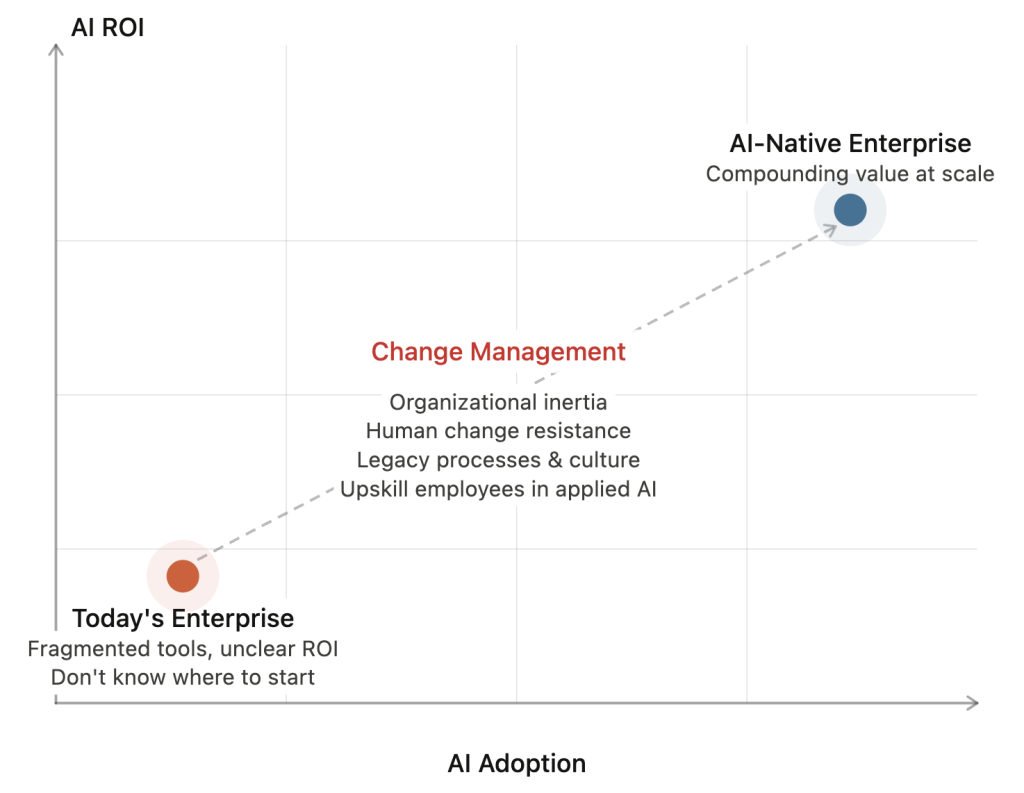
What’s Driving Urgency?
We view tech adoption urgency on a spectrum. Multinational enterprises sit at one end, and the individual consumer at the other. Regardless of your position along the spectrum, you usually need some form of air cover or external instigation to change.
What’s unique right now is that we’re seeing instigation pressure across the spectrum. It’s everything, everywhere, all at once.
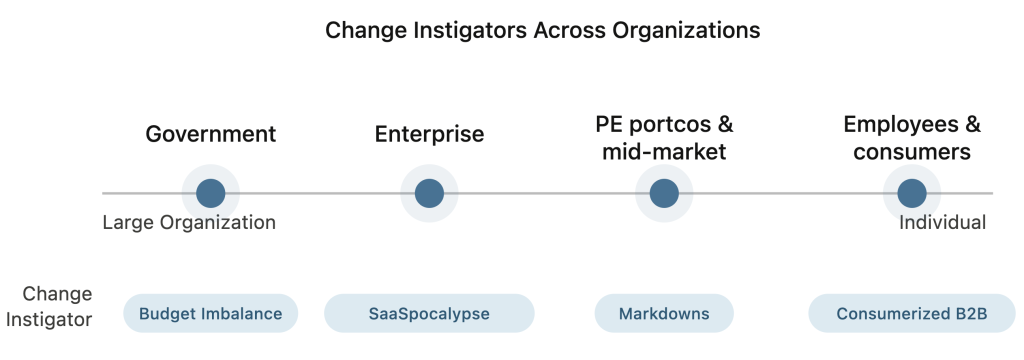
For government: Ongoing budgetary imbalances are colliding with higher constituent expectations, pushing even the most bureaucratic public organizations to adopt AI. There’s optimism that AI can simultaneously modernize the government and put taxpayer dollars to better use.
For large enterprises: Even if the ‘SaaSpocalypse’ is an overreaction, it’s pushing F500 executives to prioritize AI transformation out of fear for their job security. Fear ripples through legacy businesses, even those that missed the shift to the cloud; we hear language like ‘heads are rolling because we aren’t moving fast enough’ from both innovators and tech laggards.
For private equity PortCos and mid-market companies: LPs and GPs are studying what’s happening in public markets and see the writing on the wall in the form of markdowns. So diffusing AI across the portfolio is evolving into a performance mandate.
At the micro level, all employees are also consumers. As we interact with ChatGPT, OpenClaw or Claude, our expectations of technology change in both our personal and professional lives. Early B2B adoption of AI notetaking, vibe coding, and content creation is the tip of the iceberg.
Where’s the Opportunity?
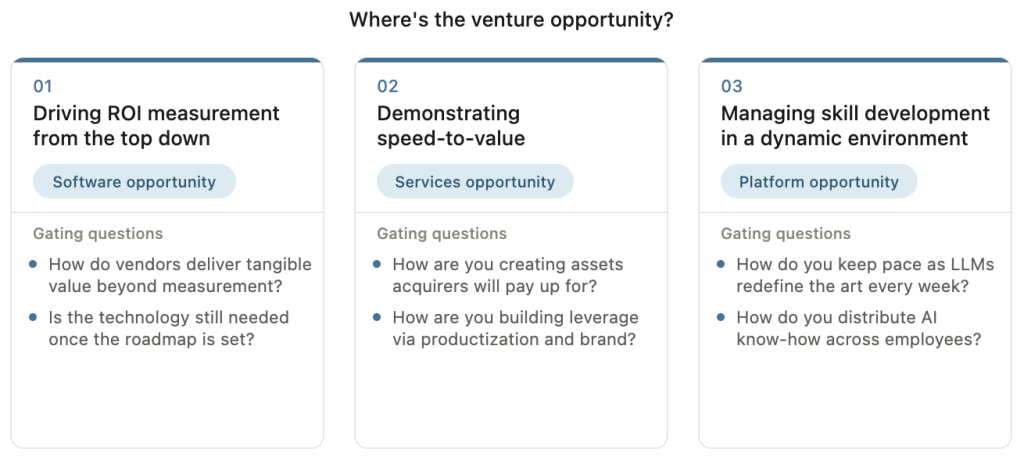
We’ve met with founders taking many different approaches to capture this opportunity. When we meet founders in this space, we’re asking three questions:
- How do you drive ROI measurement from the top down?
- How do you succeed in demonstrating fast time-to-value?
- How do you ensure your people have the skills to succeed in the AI era?
Driving ROI measurement from the top down
In past cycles, when tech adoption had a top-down mandate (think: cloud, mobile, COVID- and hybrid-work), businesses made irrational purchases. Innovation budgets swelled as firms rushed to invest in new solutions without a clear ROI framework. This resulted in bloated tech stacks, brutal renewal cycles, and millions in wasted spend.
No CEO wants to get caught making the same mistake.
So we believe there’s an opportunity to build a software business that measures AI ROI.
We’re excited about measurement software that helps CEOs answer three questions: Where should we deploy AI next? Who’s actually using it? How do I know it’s driving value?
Firms already sit on troves of telemetry across dozens of applications. Unifying these raw signals into a software layer that powers road mapping, adoption, and ROI intelligence is not technologically complex.
Building brand credibility is tricky. We’re in a land grab phase of what we suspect is a winner-takes-most market. Becoming synonymous with AI ROI measurement will boil down to buyer access and sales velocity more than early product precision. The vision can be expansive, but the best founders will have strong answers to the risks below.
How do you tie yourself to the outcome?
Our view: AI measurement itself is valuable, but without a deeper offering, it risks falling into ‘vitamin’ rather than ‘painkiller’ territory. Deployment guidance elevates the solution. Think: self-help books are fun to read, but they don’t automatically build your muscles. It’s the personal trainer who drives results.
Once the roadmap is set, is the technology still needed?
Our view: you can think of AI measurement software as a wedge into broader workflow intelligence. Once a CEO sees a clear picture of organizational (in)efficiency — with AI or otherwise — they won’t readily give that up. Across cycles, CEOs want to locate and remove waste across the org chart. AI is the “why now,” but that dynamic is evergreen.
Demonstrating speed-to-value
Time sensitivity has elevated speed-to-value, perhaps even above total impact, as a driver of market multiple expansion. Speed-to-value is driven by execution – by embedding alongside organizations and delivering transformation projects on the ground, either via the FDE model or as a third party.
We believe there’s a services opportunity here, specifically in transformation consulting.
A few exciting approaches:
- Internal automation and adoption: Consultants working alongside BUs to build customized automation and adoption tooling, then owning the implementation + adoption programs that follow
- Embedded AI in production: Expert technical talent embedding into R&D orgs to drive AI feature development, then overseeing rollout into production
- Firmwide strategy and governance: Firms building deep vertical or functional expertise to own the entire AI strategy and governance cycle, acting as a trusted advisor to leaders
You may be thinking, ‘Isn’t this Accenture?’ It’s fair pushback. And traditional consultancies are not a fit for venture because revenue scales linearly with headcount. But we’re starting to see real change here: A string of recent acquisitions at aggressive valuations/multiples suggests that incumbent consultancies themselves are afraid and are willing to buy startups at venture multiples.
We see why. There’s obvious market pull here, and the best teams we’ve met are delivering real results. But next-gen consultancies need strong points of view on two critical issues.
How are you creating assets that acquirers will pay up for?
Our view: incumbents will pay up for assets that drive competitive advantage, and, in the consulting world, the most obvious advantage is talent. Firms that control access to top technical talent pipelines (think: top AI / ML PhD programs, incubators/accelerators, etc.) have what incumbents covet.
How are you building leverage through productization, repeatability, and brand?
Our view: winners will productize services such that automation accelerates both within a customer relationship and across customers in a given vertical.
To use an example: ‘Great’ looks like transforming a one-off sales & marketing project into a proprietary sales & marketing software platform that consultants use across projects to ship outcomes faster than competitors can.
When this works, gross margin expands. Gross margin expansion allows you to win on time-to-value. Whoever delivers value faster harnesses brand advantage by becoming synonymous with transformation.
Managing talent and skill development in a dynamic environment
State-of-the-art AI is evolving so quickly and continuously that ongoing employee upskilling is a crucial pillar of successful transformation.
We’ve long believed that skills are the most important currency for contributors – not necessarily degrees or job titles. Today is no different: leaders are looking for flexible, multi-skilled people, especially in the AI era. It is incumbent upon the enterprise to facilitate upskilling; our portfolio company, Workera, has emerged as a leader in this space.
Hiring people fluent in applying AI is hard and expensive. But as the breadth of functionality grows by the day, so too does the usability of AI tools; it is getting easier to adopt AI. Blend those facets with skill development, and enterprises have an opportunity to create an army of AI-fluent workers empowered to drive change. This dynamic exacerbates what we’ve always known: people who successfully use cutting-edge technology swim, and those who don’t – sink.
Businesses that enable their people to harness the full value of AI will become crucial power brokers.
Who we want to meet
The time to strike is now: B2B buyers across the board are clamoring to buy solutions that accelerate AI transformation. Change mandates are creating opportunities for both software and services businesses to scale at exceptional speed and command premium valuations.
If any of the below sound like you, we want to meet:
- You are building the authoritative software platform to measure AI use case prioritization, adoption, and ROI in the enterprise
- You are a transformation consultancy delivering internal automation + adoption projects, embedding into your clients’ R&D orgs to ship AI into production, or specializing by function + vertical to own the AI strategy and governance cycle for your clients.
- You’re building either of the above, and have a unique edge in the form of access to AI talent, speed-to-value, or brand.
Reach out to [email protected] and [email protected].
This article is for informational purposes only and does not constitute investment advice. Views expressed represent the opinions of Jump Capital. Jump Capital may have investments in or pursue investments in the technology sectors and companies discussed. References to specific companies do not constitute investment recommendations.